Guides · Care and maintenance
Log cabin settling and expansion: why gaps appear and how to fix them
Why log cabin walls settle, shrink and swell, why gaps appear above windows or between logs, and the fixes UK makers recommend, from storm braces to slotted shelf battens.
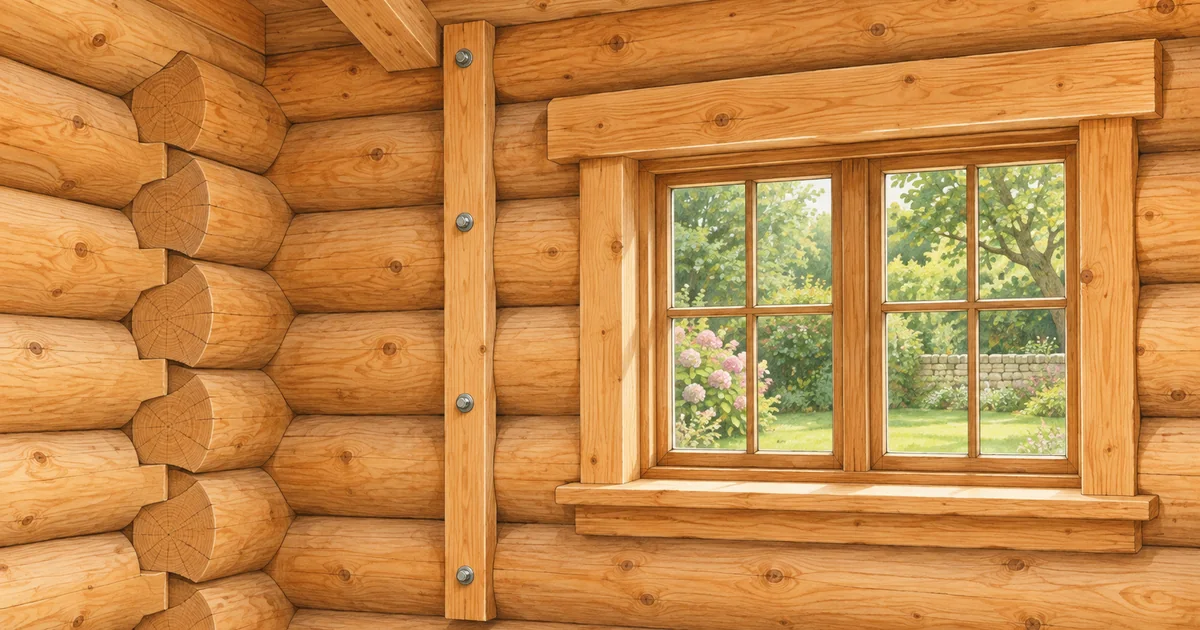
A log cabin wall is a stack of solid timber boards that interlock but are not glued or screwed to each other. Timber takes up and gives off moisture with the seasons, so the wall gets slightly taller and shorter through the year, and in the first year or so it also settles as the logs bed down. This movement is normal. Problems start when something stops the logs moving.
Why log walls move
Garden Buildings Direct explains in its guide to log cabin timber movement that most cabins are made from kiln-dried softwood processed to a moisture content of 16 to 19%, which it describes as the industry standard for construction. Timber remains reactive to its surroundings, so it keeps adjusting. The same guide says settling normally happens during the first 12 to 18 months and that minor seasonal movement continues for the life of the building. It is clear that settling is not, in itself, a sign of poor quality or a defect.
Dunster House's maintenance guide describes the same thing: after construction there is a period of settling as the wood adjusts to the climate, and the wood will shrink and settle, which can cause splits and cracks. It says these should not compromise the structure, and that splits can be filled with a matching flexible sealant.
Precision of manufacture helps the logs slide down evenly. Tiger Sheds' buyer's guide says its logs are cut to a 0.01 mm tolerance and that its 44 mm logs have a double tongue and groove; those are the maker's figures. Thicker logs are, in Tiger's words, less susceptible to movement. See log cabin wall thickness for more on 28 mm against 44 mm logs.
What blocks movement
Garden Buildings Direct lists the usual culprits. Check each one if gaps appear:
- Shelves, cupboards and electrics fixed across more than one log. One section of wall is held while the rest drops, and a gap opens.
- Storm braces fixed so tightly that they hold the logs rigidly.
- Door and window frames that are jammed. If the wall drops but the frame does not, gaps form above or around the opening.
- Internal partitions fixed tightly to the outside walls.
Dunster House adds that storm braces, the timber battens fixed with coach bolts that stop walls racking, may need the tension released on the top bolt so the brace can move, and that this should be checked regularly throughout the cabin's life.
A base that is not level causes a different problem. Forest Garden's base preparation page says the interlocking logs cope well with vertical force but will not cope with lateral forces if the base is not level. Twisting and gaps that never close can point back to the base; see log cabin base options compared.
The gap above doors and windows
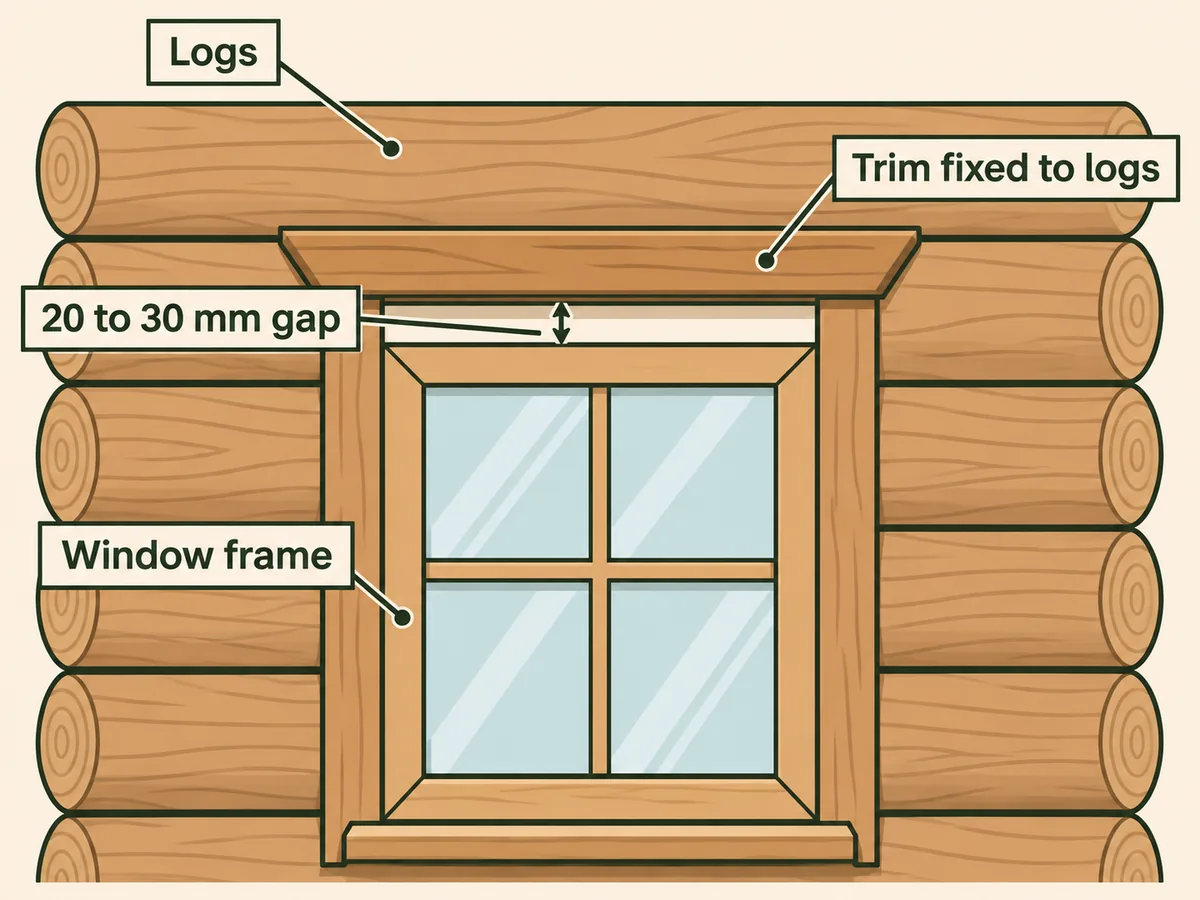
Doors and windows sit in the wall but must not carry its weight. Garden Buildings Direct says every log cabin window and door should have a settling gap of 20 to 30 mm above the frame, hidden by an architrave or trim. As the logs settle, the gap closes instead of the wall pressing down on the frame.
Signs the gap has closed include a door that catches, a window that will not open, or a frame top that looks bowed. Garden Buildings Direct's fix is to remove the trim and cut down the top of the frame to restore clearance. In severe cases where the wall has not settled evenly, it says the frame may need to come out so the logs can reach their natural position, which is a more complex repair.
Do not pack the settling gap with timber, foam or sealant to stop draughts. It locks the wall, and the movement will show up as gaps somewhere else. Garden Buildings Direct warns specifically against filling gaps with sealant or expanding foam.
Fixing gaps between logs
If a gap has opened under a shelf or fixture, Garden Buildings Direct advises:
- Remove the fixture holding the logs.
- Leave the wall to resettle on its own over the next few weeks; you cannot simply push the logs back down.
- If a small gap remains, hide it with a slim strip of matching timber pinned only to the upper log, so the two logs are not bonded together.
Fixing things to log walls the right way
To hang shelves, cupboards, a TV or a whiteboard, Garden Buildings Direct suggests the method many installers use: fix a vertical timber slat to the wall through slotted holes, using a screw and washer, so the slat can slide as the logs move. Hang your shelves from the slat rather than from the logs. The same principle applies to electrics: ask your electrician to use fixings that allow for movement, and see log cabin electrics.
Internal wall linings and insulation need the same care. Battens for a lining should be fixed so the logs can move behind them; check your cabin maker's instructions before adding any lining.
Seasonal pattern to expect
| When | What you may notice | What to do |
|---|---|---|
| First 12 to 18 months | Wall height drops; settling gaps above frames close slightly | Check doors, windows and storm braces every few months |
| Warm, dry spells | Logs shrink; small gaps or splits appear | Check nothing is fixed across logs; fill splits in individual logs with flexible sealant if needed |
| Damp, cold spells | Logs swell; doors may stiffen | Adjust door and window hinges and keepers if the manual allows |
| Any time | Gap that does not close after damp weather | Look for a fixing, tight brace, jammed frame or an uneven base |
Garden Buildings Direct notes that small gaps in the first year are usually just settling, while persistent wide gaps that do not close after damp weather may point to an installation problem.
Treatment and movement
Finishes also affect how timber handles moisture. Dunster House says oil-based treatments soak in while leaving some give so the cabin can still expand, contract and settle naturally. Keep the cabin treated on schedule so the logs take up water more slowly; see log cabin treatment and maintenance.
Summary
- Settling and seasonal movement are normal; Garden Buildings Direct says settling mostly happens in the first 12 to 18 months.
- Keep a 20 to 30 mm gap above every door and window frame, hidden behind trim fixed to the logs.
- Never fix shelves, cupboards or partitions across more than one log; use slotted vertical battens.
- Keep storm braces free to move and check their bolts regularly.
- Do not fill movement gaps with foam or sealant. Fill splits in a single log only, with flexible sealant.
- A base that is not level can stop the walls settling evenly.
Sources
Opened and checked on 15 November 2026.