Guides · Care and maintenance
Log cabin treatment and maintenance: a year-round guide
How to treat a new log cabin, which preservative types retailers describe, how often to re-treat, and a yearly maintenance checklist for UK garden cabins.
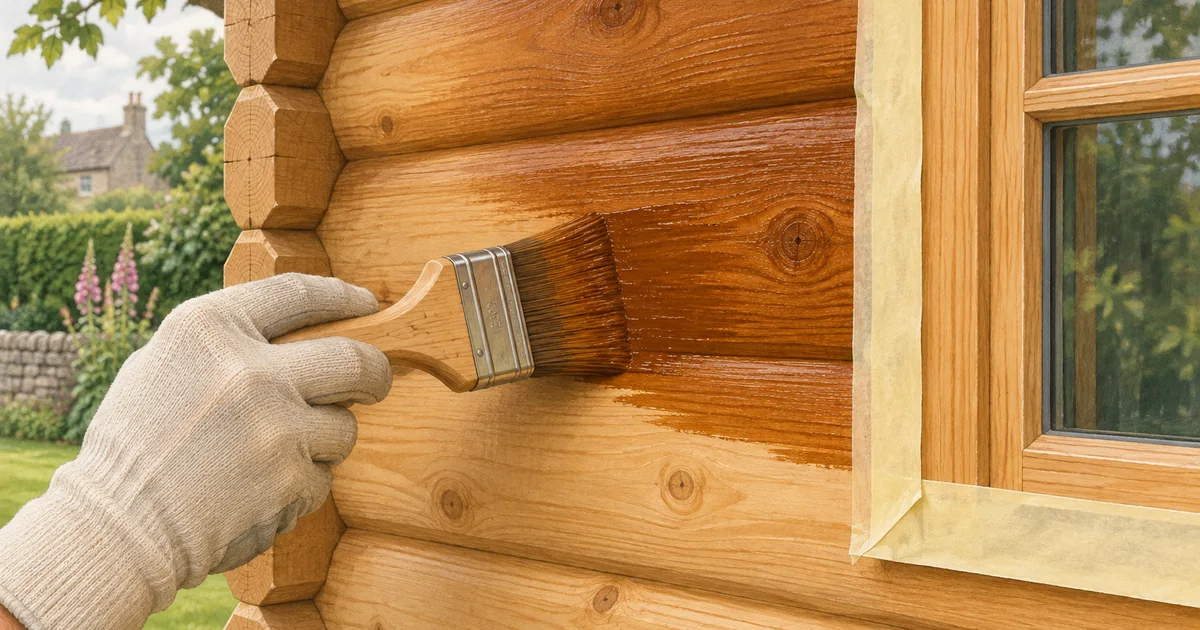
Most log cabins are sold untreated, and an untreated softwood cabin left to the British weather will grey, absorb water and eventually rot. The good news is that maintenance is mostly predictable: treat the cabin as soon as it is built, re-treat on the schedule your product needs, and check a few weak points each year.
Treat it as soon as it is built
Dunster House says in its maintenance guide that its log cabins are supplied untreated and strongly advises treating the cabin as soon as you construct it, warning that an untreated cabin will deteriorate. Forest Garden's product pages, such as the Chiltern 4.0m x 3.0m, say the cabin is supplied untreated and unpainted and that a solvent-based preservative must be applied after assembly.
That last point matters: some makers specify a type of treatment, and their warranty may depend on it. Check your cabin's manual before you buy a tin.
Types of treatment
Dunster House describes three broad types:
| Type | What Dunster House says | Re-treatment interval it gives |
|---|---|---|
| Water-based | Water resistant, applied straight onto clean, dry, sound wood; no primer | Not stated |
| Solvent or spirit-based | More protection than water-based, deep penetrating, protects against wet and dry rot | Every three to four years, depending on weather |
| Oil-based | Soaks in and leaves some "give" so the cabin can still expand, contract and settle | Touch up every four to five years; exposed sides more often |
Retailers do not all agree on intervals. Tiger Sheds' insulation article says a cabin must be painted with a specialist wood preservative at least annually. Follow your cabin maker's instructions and the instructions on the product you use, and let the water test below tell you when the finish is wearing.
Products to compare
As examples of what is sold for garden timber:
- Cuprinol Ultimate Garden Wood Preserver, Autumn Brown, 4L. The listing describes five-year performance, protection against rot, decay and blue stain, and coverage of up to 5 m² per litre on smooth planed wood and 3 to 4 m² per litre on rough sawn wood in two coats, with drying in two to six hours.
- Cuprinol 5 Year Ducksback Matt Shed and Fence Treatment, Black, 5L, listed at £19 at Wickes (checked 15 November 2026). It is sold for sheds and fences; check that its type and coverage suit your cabin maker's guidance before using it on a cabin.
Work out how much you need from the wall area. A 4 m x 3 m cabin with walls around 2 m high has roughly 28 m² of outside wall before gables and openings, and you will be applying two coats.
How to treat a cabin
Dunster House's guide sets out a sensible method:
- Choose a dry spell. If you are treating in winter, make sure the building is completely dry first.
- Mask hinges and glass, and lay sheets on the ground.
- For the best protection, take out the windows and doors by unscrewing the internal trims so you can treat behind them.
- Start at the top of each wall and do one wall at a time.
- Let each coat dry before the second.
- Coat end grain generously; Dunster House says end grains should be liberally coated to seal them.
Treat the inside of the cabin too if the maker recommends it; an internal finish slows moisture moving in and out of the logs from inside.

When to re-treat: the water test
Dunster House suggests spraying a little water onto the outside. If it beads and runs off, the finish is still working for another year. If it soaks in, it is time for a fresh coat. Check corners and log ends especially, because they can absorb water while flat faces still repel it. Clean dirty surfaces with a damp cloth first, and sand very dirty areas lightly before re-coating.
Sealing problem spots
After treatment, Dunster House suggests using silicone sealant on common problem areas: joints around windows and doors, the interlocking corners from roof to foundations, and visible gaps at log ends. It stresses using sealant only after re-applying treatment. Do not seal the gap above window and door frames or bond one log to the next; logs need to move. See log cabin settling and expansion.
The base and floor
Rot usually starts at the bottom. Dunster House's buyer's guide advises making sure the floor bearers are pressure treated, not dip treated. Its maintenance guide adds that the cabin should sit with the base raised above the surrounding ground to reduce splash-back, and that soil should not be piled against the base. If your cabin is already built, clear soil, leaves and plants away from the bottom logs. For new projects see log cabin base options compared.
A moisture meter helps you spot trouble early. The Brennenstuhl Moisture Detector MD listing gives a wood range of 5 to 50%. Take readings at the same spots each season and look for a rising trend.
Storm braces
Many cabins have storm braces: timber battens fixed with coach bolts to stop walls racking in the wind. Dunster House says it may be necessary to release the tension on the top coach bolt so the brace can move, and to check this regularly so gaps do not open between logs.
Yearly checklist
| When | Check |
|---|---|
| Spring | Roof covering for lifted or cracked felt; clear gutters and downpipes; water-bead test on walls |
| Late spring or summer, dry spell | Re-treat if the water test fails; reseal corners and window joints after treatment |
| Summer | Check doors and windows open freely; look for gaps opening between logs |
| Autumn | Clear leaves from roof and gutter; pull back soil and plants from the bottom logs; check storm brace bolts |
| Winter | Ventilate on dry days to limit condensation; check for damp patches inside |
Condensation is a winter issue: Dunster House recommends opening windows on dry days or when they are steamed up. For the roof itself, see felt, shingles or EPDM.
Summary
Treat a new cabin straight away with the type of product your maker specifies. Re-treat when water stops beading; intervals quoted by retailers range from at least annually (Tiger Sheds) to three to five years for solvent and oil-based products (Dunster House). Keep water off the bottom logs, keep gutters clear, and never bond logs together with sealant or fixings.
Sources
Opened and checked on 15 November 2026.
- dunsterhouse.co.uk/help-centre/how-to-maintain-your-garden-log-cabin
- dunsterhouse.co.uk/log-cabins-buyers-guide
- www.forestgarden.co.uk/product/chiltern-4-0m-x-3-0m-log-cabin-double-glazed-24kg-felt-plus-underlay
- www.tigersheds.com/blog/how-to-insulate-a-log-cabin-tiger-sheds
- www.wickes.co.uk/Cuprinol-5-Year-Ducksback-Matt-Shed+Fence-Treatment---Black---5L/p/156459